
By Max Thornton August 15, 2026
For businesses serving Canadian customers, Interac can be an important part of the payment mix. But accepting Interac Debit and accepting Interac e-Transfer are not the same process, and treating them as interchangeable can create confusion about equipment, fees, settlement, refunds, fraud controls, and bookkeeping.
Interac Debit is primarily a debit-card payment method used through supported point-of-sale or online acceptance environments, while Interac e-Transfer moves funds through participating financial institutions using a bank-account-based transfer workflow.
A merchant accepting Interac Debit generally works with an acquirer or compatible payment provider, while a business receiving Interac e-Transfer normally works through its participating financial institution and business bank account.
That distinction matters economically. Interac describes Debit merchant pricing as often involving low or flat transaction fees, but actual merchant costs depend on the acquirer, payment processor, terminal arrangement, service plan, and contract.
Interac e-Transfer fees, meanwhile, are determined by participating financial institutions and the business banking services being used rather than by a universal merchant rate.
For retailers and restaurants, Interac Debit may fit naturally into an existing point-of-sale checkout. For contractors, professional services, B2B sellers, landlords, freelancers, and invoice-based businesses, Interac e-Transfer for Business may be useful for collecting remote payments.
Ecommerce merchants have additional options, but online Interac availability depends on the specific product, participating financial institutions, gateway, wallet, merchant implementation, and provider support.
Businesses outside Canada should be particularly careful with eligibility assumptions. Interac’s business instructions generally revolve around Canadian bank accounts, participating financial institutions, Canadian merchant acceptance, or supported acquiring arrangements. A foreign merchant cannot assume it can activate Interac simply because it sells to Canadian customers.
This guide explains how Interac payments for businesses work, what businesses should ask providers before signing up, and how to compare their economics with credit cards and other bank-transfer methods.
What Is Interac Debit?
Interac Debit is a payment-card service that lets customers make purchases using funds associated with their bank account. At a physical merchant, customers may insert an eligible debit card and authenticate the transaction, or use contactless payment when supported.
The authorization travels through the payment ecosystem to the customer’s financial institution, which approves or declines the transaction.
For a merchant, accepting Interac Debit usually means establishing a relationship with a participating acquirer or payment processor that supports the service. Interac describes an acquirer as a service provider that offers Interac Debit terminals and service to businesses.
The customer experience is therefore much closer to ordinary point-of-sale debit card processing than to sending a bank transfer. The customer presents a card or eligible digital wallet at checkout, approves the purchase through the relevant authentication flow, and receives confirmation through the merchant’s payment terminal or checkout interface.
Contactless Interac Debit is commonly associated with Interac Flash functionality. Interac’s current business instructions state that a merchant offering contactless payments needs an appropriate payment setup through a participating acquirer and a compatible point-of-sale solution.
If contactless limits or cumulative controls require additional authentication, the customer may be prompted to insert the card and enter a PIN instead.
Digital-wallet acceptance is also part of the ecosystem. Interac currently supports eligible debit cards through participating wallet and financial-institution arrangements, including mobile payments at contactless merchants.
Businesses that already accept compatible Interac contactless transactions may not necessarily need a separate merchant configuration for every supported mobile-wallet transaction, but they should confirm compatibility with their acquirer.
What Is Interac e-Transfer?
Interac e-Transfer is a bank-account-based payment service offered through participating financial institutions. Instead of presenting a debit card to a merchant terminal, the sender initiates a transfer through online or mobile banking, and the recipient receives the funds through the Interac e-Transfer process.
For businesses, this can support customer payments, invoices, contractor and supplier transactions, deposits, and other account-to-account workflows. Interac says businesses can use its e-Transfer service for invoicing and payments when they bank with a participating bank or credit union and meet the service requirements.
A typical business setup requires a Canadian business bank account with the relevant Interac e-Transfer functionality enabled, access to online banking, and appropriate recipient information such as an email address, mobile number, or other supported identifier. Feature availability depends on the financial institution.
Unlike a card transaction, there may be no payment terminal involved at all. A customer might receive an invoice from a contractor, open their banking application, select Interac e-Transfer, enter the business’s registered payment information, and send the amount.
Businesses should nevertheless distinguish an e-Transfer notification from confirmed receipt of money. Interac explains that money itself does not travel by email or text; those channels are used for notifications and instructions.
Businesses should verify completed payment through their actual banking records rather than relying on a customer’s screenshot or forwarded notification.
Interac e-Transfer Autodeposit
Interac e-Transfer Autodeposit allows incoming transfers associated with registered contact information to be deposited into a designated account automatically rather than requiring the recipient to answer a security question for each transfer. Registration is completed through a participating financial institution, and availability can vary by institution and account.
For a business receiving frequent payments, Autodeposit can eliminate a manual acceptance step. That can be valuable when several employees issue invoices or when customers send payments outside normal office hours.
Autodeposit does not remove the need for reconciliation. A deposit reaching the correct bank account proves that money was received, but accounting staff still need to determine which invoice, customer, location, or project the payment belongs to.
The feature can also reduce exposure to some forms of phishing because the business does not need to follow a link to accept every transfer.
Even so, businesses should maintain controlled banking permissions, review account activity, and investigate unexpected transfers rather than assuming every deposit is connected to a legitimate sale. Interac states that Autodeposit occurs subject to routine fraud checks by participating financial institutions.
Request Money for Businesses
Request Money reverses the usual initiation flow. Instead of waiting for a customer to manually create an e-Transfer, a business sends a payment request to the customer, who reviews and approves the request through a supported banking experience.
Interac describes Request Money as suitable for billing clients and customers, and its business guidance allows information such as an invoice number to be included in the message field, subject to message limitations.
Interac also offers a Business Request Money capability for participating financial institutions. The company describes possible implementations involving websites, mobile applications, QR codes, invoices, storefront transactions, and other embedded payment experiences.
Availability is not universal, however, so a business should confirm whether its bank and implementation provider currently support the required version of Request Money.
For service companies and B2B organizations, a properly designed Request Money workflow can improve reconciliation because the business initiates the request and can associate it with an invoice or customer record before payment arrives.
Interac Debit vs. Interac e-Transfer
The easiest way to understand business Interac payments is to separate the card-based checkout experience from the bank-transfer experience.
| Feature | Interac Debit | Interac e-Transfer |
| Typical use | Retail and other checkout payments | Remote payments, invoices and account-to-account transfers |
| Payment channel | POS terminal, supported contactless or eligible online environment | Participating bank or credit-union banking service |
| Terminal required | Usually for traditional in-person card acceptance; supported software-based contactless options may differ | No traditional card terminal required |
| Customer experience | Present card or digital wallet and authorize purchase | Send or approve a transfer through banking |
| Merchant setup | Acquirer/processor and compatible acceptance environment | Eligible account and participating financial institution |
| Pricing | Merchant/acquirer contract; may include transaction and service costs | Bank or account-plan pricing |
| Confirmation | Card authorization at checkout | Confirmation through participating financial institutions |
| Refund workflow | Usually through the merchant’s supported payment system and agreement | Often requires a separate repayment or institution-supported process |
| Best fit | High-frequency consumer checkout | Invoice-driven, remote and many B2B/service workflows |
Interac Debit is built around merchant acceptance infrastructure. Interac’s merchant materials tell businesses to work with a participating acquirer for terminal-based acceptance, while its e-Transfer business materials tell businesses to work with their bank or credit union.
The difference affects everything from employee training to bookkeeping. At a retail counter, the POS already knows the sale amount and can associate the approved Interac Debit transaction with the receipt. With e-Transfer, the accounting link may depend on the payer’s message, an invoice reference, Request Money metadata, or a separate reconciliation process.
Refunds are another important distinction. A business should not assume that sending money back after an e-Transfer purchase is identical to processing a terminal-based debit refund. The applicable functionality depends on the product, bank, acquirer, gateway, and merchant agreement.
The result is that neither option is automatically “better.” Interac Debit is often more natural at a checkout counter, while e-Transfer can be very practical when the commercial relationship already revolves around invoices or direct communication.
How Businesses Accept Interac Debit

A typical Interac Debit setup starts with the merchant’s acquiring relationship rather than directly with the customer’s bank. Interac states that merchants should speak with a participating acquirer to arrange an appropriate payment acceptance solution.
A practical setup process usually looks like this:
- Establish a compatible merchant or acquiring relationship: Confirm that the provider supports Interac Debit for your business type and payment channel.
- Choose compatible acceptance equipment or software: Determine whether you need a countertop terminal, mobile device, integrated POS, or another supported configuration.
- Complete merchant onboarding: Provide the business, banking, ownership, and underwriting information requested by the provider.
- Enable Interac Debit acceptance: Verify that the relevant debit application and contactless functionality are properly configured.
- Test transactions and reporting: Test chip/PIN and contactless flows that are relevant to your setup.
- Create a reconciliation procedure: Match POS totals to processor reports, settlement records, and bank deposits.
Do not evaluate a terminal solely by whether it says “debit compatible.” Ask whether it supports the exact Interac functionality you expect to offer and whether that functionality is enabled under your merchant agreement.
Interac Debit at the Point of Sale
At a conventional point of sale, an Interac Debit transaction begins when the merchant enters or transmits the sale amount and the customer presents an eligible payment credential. Depending on the transaction and equipment, the customer may insert a chip card and enter a PIN or make a contactless payment.
Interac states that chip-and-PIN and contactless transactions are approved through secure systems by the customer’s bank or credit union in real time. For contactless merchant acceptance, Interac instructs merchants to work through participating acquirers.
A smartphone or digital wallet can also be used in supported environments. Interac’s business FAQ states that its mobile point-of-sale functionality works with supported digital wallets and that merchants already offering compatible contactless acceptance should check with their acquirer regarding mobile acceptance.
Retailers should train employees to follow terminal prompts rather than manually deciding when a customer should tap, insert, or use another payment method. Authorization rules and contactless limits are part of the payment system and issuing-bank controls, not something a cashier should attempt to override.
Interac Debit for Ecommerce
Interac Debit can participate in online commerce, but merchants should not assume that every ecommerce gateway or every customer’s debit card automatically supports it.
Interac currently describes in-app and in-browser debit payments through eligible digital wallets at participating merchants and financial institutions. Customers may choose Interac Debit within Apple Pay or Google Pay in a supported checkout environment when their financial institution and payment setup are eligible.
Interac’s business materials also describe additional online payment offerings. Its business FAQ identifies Interac Debit for Online Payments and separately describes Interac Direct through participating merchants and the KONEK gateway.
These are distinct implementations with their own requirements rather than a universal “Interac button” that any foreign or domestic website can switch on.
Before advertising ecommerce Interac payments, ask the gateway or acquirer which specific Interac product is supported, which customers can use it, how refunds work, and how transactions appear in settlement reports.
How Businesses Accept Interac e-Transfer
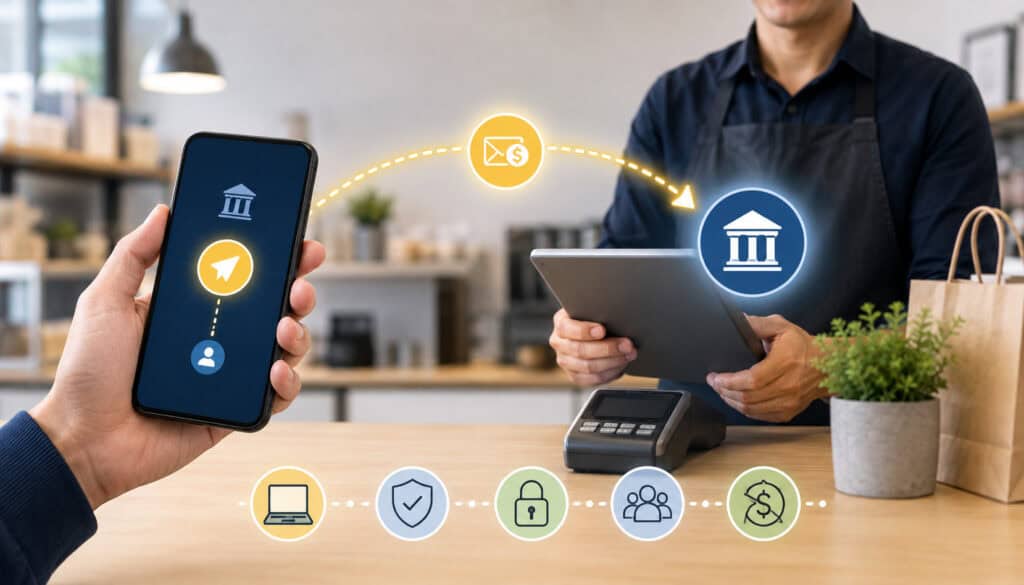
For many small businesses, accepting Interac e-Transfer can be operationally simpler than adding another card terminal because the receiving side is built around an eligible business banking relationship.
Interac’s business instructions state that businesses using Interac e-Transfer for Business need a Canadian business bank account with the service enabled, supported contact information, and access to online banking through their financial institution.
A basic receiving workflow may be:
- Confirm that the business account supports Interac e-Transfer.
- Register the appropriate business email address or mobile number.
- Configure Autodeposit if it suits the company’s controls and workflow.
- Determine whether Request Money or Business Request Money is available.
- Establish invoice-reference rules for customers.
- Train employees to verify deposits through the bank account rather than customer screenshots.
- Reconcile incoming transfers against invoices and accounting records.
Businesses should also decide who is permitted to view, receive, request, or send transfers. Using one owner’s personal banking workflow for business collections can become difficult to control as transaction volume grows, and businesses should verify that their account type and bank terms permit the intended use.
For accounting teams, the objective should be to make an e-Transfer as traceable as possible from invoice to bank deposit.
Interac Fees and Flat-Fee Payment Economics
There is no single universal Interac merchant fee that applies to every business. This is one of the most important points for anyone researching Interac Debit merchant fees or Interac e-Transfer business fees.
For Interac Debit, merchant pricing is established through the acquiring and processing relationship. Interac describes the service as having low, often flat transaction fees, but the merchant’s actual total cost can include processor pricing, terminal charges, monthly service fees, administration costs, connectivity, software, and other contracted charges.
Canadian merchants should therefore read their contract and monthly statements instead of assuming the network-level pricing description equals their all-in cost.
Canada’s Financial Consumer Agency states that merchant-acquirer agreements are subject to disclosure requirements under the Code of Conduct for the Payment Card Industry in Canada, including disclosure of relevant fees and contract information.
For a useful discussion of how extra processing charges affect the effective cost of acceptance, see avoiding hidden fees in Canadian merchant accounts.
Interac e-Transfer pricing is different. Interac states that banks and credit unions determine pricing for business-related services such as Bulk Disbursements, and financial institutions may incorporate e-Transfer fees into specific business banking packages or transaction schedules.
Understanding Flat-Fee Payment Economics
A flat transaction charge behaves differently from a percentage-based processing charge because the cost does not rise directly with the dollar value of the purchase.
A simplified flat-fee formula is:
Flat Fee Cost = Number of Transactions × Per-Transaction Fee
A simplified percentage-based model might be:
Percentage-Based Cost = Sales Volume × Processing Percentage + Fixed Transaction Fees
These formulas are illustrations, not Interac pricing quotations.
Suppose a hypothetical payment method costs $0.15 per completed transaction. A $10 purchase and a $500 purchase would each create the same $0.15 transaction cost under that simplified model.
Now suppose another hypothetical payment method costs 2.5% plus $0.10. A $10 payment would cost $0.35, while a $500 payment would cost $12.60.
That does not mean the first payment method is universally cheaper. Businesses must consider monthly charges, terminal rental, banking fees, gateway costs, refunds, unsuccessful payments, accounting workload, customer conversion, and the actual merchant agreement.
| Transaction Size | Flat-Fee Model | Percentage-Based Model | Main Consideration |
| Small ticket | Fixed fee may represent a larger percentage of sale | Percentage component stays relatively small, but fixed component matters | Compare effective cost per transaction |
| Medium ticket | Fixed cost remains unchanged in a true flat-fee model | Percentage cost rises with sale amount | Merchant agreement becomes important |
| Large ticket | Fixed-fee economics may become attractive | Percentage cost can become materially larger | Limits, fraud controls and customer preference also matter |
A break-even calculation can help. If a hypothetical percentage-only card cost is 2.5% and an alternative payment costs a flat $0.25, ignoring all other fees, the theoretical break-even ticket is $10 because 2.5% of $10 equals $0.25.
Real merchant pricing is more complicated. Businesses comparing payment methods should model actual statements rather than relying on marketing headlines. For more background on percentage-driven card pricing, see this guide to interchange-plus pricing and merchant fees.
Interac Compared With Credit Cards and Other Transfers
Cost is only one factor in payment acceptance. Customer convenience, authorization, dispute handling, recurring billing, accounting integration, geographic reach, and sales conversion can matter just as much.
Interac Debit vs. Credit Cards
Interac Debit normally draws on funds associated with the customer’s deposit account, whereas a credit-card purchase uses the customer’s available credit. Both can provide a familiar card-like checkout experience, but their economics and network rules differ.
Credit-card merchant pricing frequently includes percentage-based components, while Interac Debit pricing may be structured differently and can involve flat transaction charges depending on the agreement. FCAC notes that card-processing fees vary according to merchant plans, networks, card types, transaction types, and other contractual factors.
Customer motivations also differ. Some consumers value credit-card rewards, purchase protections, credit availability, or recurring billing convenience. Others prefer debit because they are spending directly from available funds.
Disputes should not be oversimplified. Merchants should not assume Interac Debit uses the same procedures, deadlines, liability rules, or chargeback mechanisms as a credit-card network. The applicable merchant agreement and payment-network procedures govern how a particular problem is handled.
Interac e-Transfer vs. Credit Cards
Interac e-Transfer replaces a card authorization workflow with a bank-based transfer workflow. That can reduce payment-acceptance costs in some situations, but it can also introduce additional customer steps if the transfer is not embedded into the billing or Request Money process.
For an invoice-based business, asking a known customer to pay through online banking may be perfectly acceptable. For a high-conversion ecommerce checkout, requiring a shopper to leave the normal purchase flow and manually create a transfer could increase friction.
Recurring billing is another important difference. Conventional card platforms commonly support stored credentials and automated subscription billing. A basic person-to-business e-Transfer collection workflow should not automatically be treated as a substitute for that functionality.
Refunds and payment disputes also operate differently. Interac itself explains that it acts as a facilitator in the e-Transfer ecosystem and does not directly hold, recall, or cancel customer funds; bank-level questions and unauthorized-transaction investigations must generally be handled through the relevant financial institution.
Interac e-Transfer vs. ACH
Interac e-Transfer and ACH should not be treated as different names for the same service. They belong to different payment environments, operate under different rules, and serve different geographic and banking contexts.
“ACH” is commonly used for automated clearing-house bank transfers, especially in the United States. Canada has its own clearing infrastructure, including systems operated by Payments Canada. Payments Canada is responsible for national payment clearing and settlement infrastructure and establishes applicable rules and standards for its systems.
Interac e-Transfer, by contrast, is an Interac service delivered through participating financial institutions. From the merchant’s perspective, that distinction affects setup, banking relationships, remittance information, limits, availability, and transaction handling.
A cross-border company should therefore choose payment rails according to the customer’s banking system rather than assuming its U.S. ACH setup automatically provides Interac acceptance.
Interac e-Transfer vs. Wire Transfers
Wire transfers are generally designed for bank-to-bank movement of funds through wire-payment infrastructure and may be used for larger, formal, domestic, or international transfers depending on the institutions involved.
Interac e-Transfer is designed around participating Interac-enabled financial institutions and its own recipient and notification workflows.
From a business user’s perspective, wires often require more banking information and can have different fees, processing controls, deadlines, and compliance procedures.
Interac e-Transfer can be more convenient for many routine domestic commercial payments because the sender may use an email address, mobile number, or supported account identifier rather than full wire instructions.
Neither method should automatically replace the other. Large-value payments, international transactions, supplier requirements, limits, treasury controls, and the recipient’s banking setup all influence the appropriate choice.
Best Business Use Cases for Interac Payments
Interac Debit is generally strongest where the customer is already at a checkout. Retail stores, restaurants, cafés, hospitality businesses, service counters, salons, clinics, trades businesses taking payment in person, and other face-to-face merchants can incorporate it alongside credit cards and other payment methods.
The customer does not need to create a new payee or manually enter payment information. They can use a supported debit card or eligible digital wallet, making Interac Debit a practical option for routine consumer purchases.
Interac e-Transfer tends to fit workflows in which the merchant and customer already communicate outside a checkout terminal. Professional services, independent contractors, consultants, freelancers, property-related businesses, B2B sellers, and companies collecting invoice balances may find that model more natural.
Businesses using e-Transfer for large invoices must still evaluate transaction limits. Interac says limits are established by financial institutions and can vary by account and service. Businesses should never promise customers that a particular transaction amount will be available simply because another bank or account supports it.
For small-ticket sales, convenience may outweigh a minor fee difference. Asking someone buying a coffee to manually create a bank transfer would generally add unnecessary friction, whereas tapping a debit card fits naturally into the checkout process.
For high-ticket services, the economic picture can reverse. When percentage-based processing expenses grow with transaction size, a bank-transfer or flat-fee option can become financially attractive, assuming the amount falls within applicable limits and the customer is comfortable with the workflow.
Can Interac e-Transfer Replace Card Processing?
For some businesses, e-Transfer can replace cards for a meaningful portion of invoice payments. It generally should not be viewed as a universal replacement for card processing.
Cards can offer highly integrated ecommerce checkout, recurring billing, card-on-file workflows, international acceptance, automated authorization, and familiar customer experiences. A basic e-Transfer flow may require more active participation from the payer and different reconciliation procedures.
Customer choice also matters. A merchant that saves a small amount in processing expense but loses sales because customers cannot use their preferred payment method may not actually improve its economics.
A better strategy is often to match the payment method to the sale. An in-person consumer purchase might favor debit or credit cards, while a $3,000 consulting invoice could be suitable for e-Transfer if both parties’ banking arrangements support the amount and workflow.
Settlement, Reconciliation, Refunds, and Disputes
Payment completion involves more than seeing “approved” on a screen. Merchants should distinguish authorization, transaction completion, processor settlement, and the point at which a deposit becomes visible in the merchant’s bank account.
For card transactions, FCAC describes a process in which authorization occurs first and approved transactions are later grouped and submitted into settlement. Processor practices differ, including whether fees are deducted before or after merchant funding.
That means businesses should not promise a universal Interac Debit funding schedule. Funding depends on the processor, merchant agreement, banking relationship, batching procedures, weekends, holidays, risk controls, and other operational factors.
Interac Debit Reconciliation
A useful daily control is:
POS Transactions → Batch/Processor Report → Settlement → Bank Deposit → Accounting
Start with the sales recorded in the POS. Compare the number and dollar value of Interac Debit transactions to the processor’s batch or settlement report.
Next, identify the related deposit in the operating bank account. Account for fees separately if the processor nets charges from deposits rather than billing them later.
Finally, record the activity in the accounting system using the same categories consistently. Differences should be investigated rather than automatically posted to a miscellaneous clearing account.
Businesses with several locations should also reconcile by terminal, merchant ID, store, or settlement batch so discrepancies can be traced efficiently. This payment reconciliation guide provides additional background on matching transaction activity, refunds, fees, and settlement records.
Interac e-Transfer Reconciliation
Interac e-Transfer requires a slightly different control because the bank deposit itself may be the first structured record available to the accounting team.
Whenever possible, capture:
- invoice number;
- customer or company name;
- transfer reference;
- amount;
- payment date;
- relevant project or location;
- bank transaction record; and
- accounting entry.
Interac’s business guidance specifically allows optional messages or invoice numbers in certain transfer and Request Money workflows, which can help with matching.
Do not rely only on the customer’s display name. Multiple customers can have similar names, customers may pay from another person’s account, and a single payer may cover several invoices.
Refunds and Reversals
Refund handling must be evaluated by payment method.
For Interac Debit, refund capabilities can depend on the acquirer, terminal, processor, transaction type, and merchant agreement. Businesses should ask whether full and partial refunds are supported, whether the original payment credential is needed, how long refund processing takes, and how the transaction appears in reports.
For e-Transfer, do not assume a completed incoming transfer behaves like a credit-card sale that can simply be “voided” from a merchant dashboard. Interac states that it does not directly hold, recall, cancel, or decide whether to reverse e-Transfer funds; account-level matters are handled through participating financial institutions.
A merchant returning money may therefore need to initiate a separate outgoing payment or use whatever supported repayment process its financial institution provides. That repayment should be linked to the original sale in the accounting records.
Chargebacks and Disputes
The word “chargeback” is strongly associated with card-network dispute processes, so businesses should avoid applying it loosely to every payment disagreement.
Interac Debit, credit cards, and Interac e-Transfer do not necessarily share identical dispute mechanisms. Unauthorized payments, merchant disagreements, duplicate transactions, fraud claims, and customer-service disputes may be handled through different processes depending on the network, merchant provider, or financial institution.
Interac’s Ombudsman’s Office states that Interac itself cannot determine whether to refund or reverse an e-Transfer and does not investigate unauthorized transactions within a customer’s bank account. Those matters must be addressed through the relevant financial institution.
For debit-card merchant issues involving contracts and acquiring services, Canadian merchants also have protections under the Code of Conduct for the Payment Card Industry in Canada. FCAC monitors participating payment card networks’ implementation of that Code.
Fraud Prevention and Payment Verification
Interac payments have security controls, but businesses still need operational fraud prevention.
One of the most common risks around e-Transfer is treating an email, SMS notification, screenshot, or customer phone display as proof that a transfer has been received. Fraudsters can create convincing fake notifications.
Interac advises recipients to verify unexpected transfers and states that legitimate email notifications include identifying information, while recipients should use their actual financial institution to complete or confirm the transaction.
The safest merchant procedure is simple: do not release goods, issue a refund, or mark an invoice paid solely because someone shows you a transfer screenshot. Confirm the transaction in the business’s bank account or trusted banking application and reconcile it to the sale.
Autodeposit may reduce the need to follow acceptance links, but it does not eliminate account-security risks. Businesses should use strong unique credentials, multifactor authentication where available, controlled user permissions, transaction alerts, and documented approval procedures.
Payment-redirection fraud is another concern. An attacker who compromises a vendor’s or employee’s email may send replacement e-Transfer instructions. Businesses should verify unusual changes to payment destinations through an independent communication channel before sending money.
Interac Payments for Businesses Serving Canadian Customers From Abroad
Interac is centered on the Canadian payments ecosystem, so international businesses should not assume that serving Canadians automatically makes them eligible for domestic Interac merchant acceptance.
Interac’s contactless merchant instructions refer to participating acquirers and a Canadian bank account, while its e-Transfer receiving instructions refer to a Canadian bank account with a participating financial institution.
A company operating in both Canada and another country may be able to accept Interac through its Canadian entity, Canadian acquiring relationship, supported gateway, or qualifying banking arrangement. The exact structure depends on the business and provider.
A company with no Canadian banking or acquiring relationship should ask its payment provider whether it offers a supported method for Canadian customers. It should not advertise “Interac accepted” until the provider confirms the specific implementation.
Merchants should also distinguish domestic Interac acceptance from international money-transfer services that may use Interac branding or partnerships. Those are not necessarily the same as enabling ordinary Interac Debit or e-Transfer merchant acceptance on a foreign website.
Cross-border businesses should compare Interac alongside international cards, local bank-transfer methods, currency-conversion costs, settlement currencies, refunds, and customer support requirements.
Interac Payments and Bookkeeping
Good bookkeeping should make payment methods visible rather than combining all deposits into one undifferentiated sales account.
A practical accounting structure may separately identify:
- gross sales;
- Interac Debit receipts;
- Interac e-Transfer receipts;
- credit-card receipts;
- payment-processing fees;
- bank service fees;
- refunds;
- customer deposits;
- settlement clearing; and
- transfers between business accounts.
This structure helps management understand the true merchant payment costs associated with each channel.
For example, if Interac Debit costs appear low at the transaction level but the business pays separate monthly terminal and service charges, those costs should be included when calculating the channel’s effective acceptance expense.
Likewise, e-Transfer may appear almost free if a business looks only at one incoming payment, but the relevant business account could have package fees, transaction charges, or staff reconciliation costs. All of these belong in an economic comparison.
Reconciliation controls also make fraud easier to identify. An unexplained refund, unmatched bank transfer, unusual settlement difference, or duplicate amount should generate investigation rather than disappear into a general ledger adjustment.
Common Interac Payment Mistakes
The most common mistake is assuming that Interac Debit and e-Transfer are simply two versions of the same payment product. One is principally a merchant debit-card acceptance method, while the other is a bank-account transfer service.
Other avoidable mistakes include:
- assuming every bank charges the same Interac e-Transfer fee;
- quoting a universal Interac Debit merchant rate;
- treating a screenshot or email as conclusive payment confirmation;
- failing to include invoice references on transfers;
- assuming all customers have identical transaction limits;
- assuming e-Transfer disputes work like credit-card chargebacks;
- using personal banking arrangements for commercial volume without reviewing account terms;
- advertising online Interac acceptance before confirming gateway support;
- overlooking monthly terminal, software, gateway, or bank-plan costs;
- failing to test refund workflows before going live; and
- assuming a foreign business can activate Interac without an appropriate Canadian relationship.
One particularly costly error is comparing payment methods using only the advertised per-transaction fee. The economically relevant figure is the total cost to accept, reconcile, support, refund, and administer the payment.
Business Payment Method Comparison
Businesses rarely need to choose only one payment rail. A combination of payment methods can provide better economics and customer coverage than forcing every sale through the same channel.
| Payment Method | Typical Channel | Pricing Structure | Customer Convenience | Merchant Considerations |
| Interac Debit | POS/contactless and supported online environments | Merchant/acquirer pricing; may include flat transaction fees plus service costs | High for eligible Canadian debit customers | Terminal/gateway compatibility, settlement, refunds |
| Interac e-Transfer | Online/mobile banking | Financial-institution or account-plan pricing | Strong for invoices and known payers | Limits, reconciliation, bank eligibility, refund workflow |
| Credit card | POS, ecommerce, mobile, recurring billing | Often percentage plus fixed or other processor pricing | Very high and broadly familiar | Chargebacks, card fees, international acceptance |
| Bank transfer/ACH | Bank and treasury systems | Varies by network, bank and service | Good for appropriate account-to-account payments | Different rules, timing and geographic coverage |
No column should be read as a universal pricing guarantee. Merchant agreements and bank plans determine the real cost.
The best payment portfolio usually follows customer behavior. A restaurant may prioritize Interac Debit and credit cards. A consulting company may accept cards for convenience but encourage e-Transfer for large invoices.
An ecommerce company may need card acceptance plus whichever supported Canadian payment methods its gateway can reliably provide.
How to Choose Between Interac Debit and e-Transfer
Start with the transaction environment.
If customers normally pay while standing at a counter, Interac Debit is likely to fit the workflow better. If customers normally receive an invoice and pay later, Interac e-Transfer may fit naturally.
Then evaluate the average ticket. Flat-fee payment economics can become increasingly attractive as purchase size rises, but transaction limits and customer banking capabilities can constrain e-Transfer use.
Consider transaction frequency as well. Hundreds of small daily purchases demand fast checkout and automated POS reconciliation. A handful of large monthly invoices can tolerate a more deliberate transfer workflow.
Next, evaluate operational requirements:
- Does the business need recurring billing?
- Are partial refunds common?
- Is ecommerce checkout conversion important?
- Do customers expect card rewards?
- Can the accounting system reconcile transfers efficiently?
- Do employees need payment permissions?
- Are sales primarily domestic or cross-border?
- How quickly does the business need confirmation?
- What bank, terminal, processor, and monthly fees apply?
Finally, compare total economics rather than individual transaction rates.
A payment method with a slightly higher direct fee may still be worthwhile if it increases sales, reduces accounts-receivable work, provides better reporting, or makes refunds easier. Conversely, an inexpensive bank-transfer option can be attractive for large invoices where customers already expect to pay through their bank.
Interac Setup Checklist
Businesses can use the following checklist before enabling either payment method.
For Interac Debit
- Confirm that the processor or acquirer supports Interac Debit.
- Verify the merchant’s business type and geographic eligibility.
- Confirm terminal or POS compatibility.
- Ask whether chip-and-PIN acceptance is enabled.
- Confirm contactless/Interac Flash functionality.
- Determine whether eligible mobile-wallet transactions are supported.
- Verify ecommerce functionality separately from in-person acceptance.
- Review transaction, terminal, monthly, software, and other fees.
- Test transaction approval and decline workflows.
- Test available refund functionality.
- Confirm settlement reporting.
- Create a daily reconciliation process.
For Interac e-Transfer
- Confirm that the business bank account is eligible.
- Review the institution’s Interac e-Transfer for Business features.
- Confirm sending and receiving limits applicable to the account.
- Review applicable transfer and account-plan fees.
- Register business contact information.
- Evaluate Autodeposit.
- Ask whether Request Money or Business Request Money is supported.
- Establish employee banking permissions.
- Define invoice-reference requirements.
- Create payment-verification controls.
- Document refund or repayment procedures.
- Reconcile transfers to invoices and bank records.
Questions Businesses Should Ask Payment Providers and Banks
The answers to a few specific questions can prevent expensive misunderstandings.
For an Interac Debit provider, ask:
- Do you support Interac Debit for my business type?
- Is contactless Interac Debit supported?
- Does my existing terminal support the required functionality?
- Can I accept Interac Debit online or in-app?
- Which online Interac product is actually being offered?
- What per-transaction charges apply?
- What monthly, terminal, gateway, software, minimum, or administrative fees apply?
- How are full and partial refunds handled?
- How does settlement work?
- How will Interac Debit transactions appear in reports?
- Are digital-wallet transactions supported?
For a bank or credit union, ask:
- Does this business account support Interac e-Transfer for Business?
- What limits apply to receiving, sending, and Request Money?
- What fees are included in my account package?
- Is Autodeposit available?
- Is Request Money or Business Request Money available?
- Can multiple employees have controlled access?
- What transaction reports can be exported?
- Are bulk receivable or payable options available for our volume?
- How should disputed or mistaken transfers be handled?
- What fraud controls and alerts are available?
Canada’s payment-card Code of Conduct emphasizes merchant pricing transparency and choice, so card-acceptance businesses should read contract disclosure materials rather than relying solely on sales summaries.
Frequently Asked Questions
How can a business accept Interac Debit?
A business typically accepts Interac Debit through a participating acquirer or payment processor that provides compatible acceptance equipment or software. The merchant completes onboarding, enables the required Interac functionality, tests transactions, and establishes reporting and settlement procedures.
Contactless acceptance depends on the terminal or device configuration. Interac directs merchants to participating acquirers for setup and troubleshooting.
Can businesses accept Interac e-Transfer?
Yes. Interac states that businesses can use Interac e-Transfer for invoicing and payment needs when they bank with a participating institution and meet the applicable account requirements.
A business may receive ordinary transfers, use Autodeposit, or access Request Money and other business features where its financial institution supports them.
What is the difference between Interac Debit and Interac e-Transfer?
Interac Debit is primarily a debit-card payment method used through a merchant acceptance environment such as a POS terminal or supported digital checkout.
Interac e-Transfer is a bank-account-based transfer initiated or approved through participating financial institutions. Debit acceptance typically involves an acquirer, while e-Transfer acceptance revolves around the business’s eligible banking relationship.
How much does Interac Debit cost a merchant?
There is no universal merchant price. Interac describes Debit fees as often low and flat, but the amount a specific business pays depends on its acquirer, processor, pricing plan, equipment, software, and merchant contract. Businesses should also count monthly and terminal costs when calculating effective acceptance expenses.
Does Interac e-Transfer charge businesses a fee?
It depends on the financial institution and account plan. Business accounts may include transfers within a package or apply transaction and service charges. Interac states that participating banks and credit unions determine pricing for business features such as Bulk Disbursements. Always check the institution’s current business fee schedule.
Is Interac cheaper than credit cards?
Sometimes, but not universally. A flat debit or bank-transfer charge can be economically attractive relative to percentage-based card pricing, particularly for larger tickets.
However, the correct comparison includes terminal costs, banking fees, monthly fees, gateway costs, customer conversion, reconciliation labor, refunds, and the actual card rate.
Does Interac use a flat transaction fee?
Interac Debit merchant pricing is often described by Interac as involving low or flat transaction charges, but a merchant’s contract determines the actual structure.
Interac e-Transfer pricing is set through participating financial institutions. Businesses should therefore avoid treating “Interac” as one universal flat-fee pricing model.
Can Interac Debit be accepted online?
Yes, in supported environments, but availability is not universal. Interac currently describes online and in-app debit acceptance through eligible digital wallets at participating merchants and financial institutions, along with other specific ecommerce products. Merchants must confirm which implementation their gateway or provider actually supports.
Does a business need a card terminal for Interac Debit?
A traditional POS terminal is common for in-person acceptance, but not every implementation requires a separate dedicated countertop terminal.
Interac also describes supported contactless acceptance technologies such as Tap to Pay on compatible smartphones through participating payment applications. The business should confirm requirements with its acquirer.
What is Interac e-Transfer Autodeposit?
Autodeposit automatically deposits incoming eligible e-Transfers associated with registered contact information into a designated account rather than requiring the recipient to answer a security question. It can reduce manual payment handling, but businesses still need to reconcile each deposit to the correct customer or invoice.
Can businesses use Request Money?
Yes, when the relevant feature is supported by their participating financial institution. Request Money lets the business send a payment request to a customer, who then approves the payment through the supported banking process. Interac also offers Business Request Money capabilities for participating institutions and implementations.
Are Interac e-Transfer payments reversible?
Businesses should not assume a completed e-Transfer can be reversed like an uncompleted card authorization. Interac states that it does not directly recall, cancel, or reverse customer funds and does not decide whether an e-Transfer should be refunded.
Questions involving completed transfers, fraud, or mistaken payments should be handled through the appropriate financial institution.
How should businesses verify an e-Transfer payment?
Check the actual business banking account or trusted banking application. Do not release goods or issue refunds based only on an email, text message, or screenshot.
Interac recommends verifying unexpected payments and notes that payment notifications should be treated carefully because phishing attempts can imitate legitimate communications.
How do businesses reconcile Interac payments?
For Interac Debit, match POS transactions to processor batches, settlements, bank deposits, and accounting entries. For e-Transfer, match the bank transaction to the customer, invoice number, transfer reference, amount, and date. Consistent payment references and dedicated clearing accounts can make differences easier to identify.
Can a business outside Canada accept Interac payments from Canadian customers?
Possibly, but not automatically. Eligibility depends on the specific Interac product and the merchant’s acquiring, banking, gateway, or business arrangements.
Interac’s standard business instructions frequently involve Canadian bank accounts, participating financial institutions, or Canadian merchant acceptance. Cross-border merchants should confirm eligibility before advertising Interac as an available payment method.
Conclusion
Accepting Interac Debit and accepting Interac e-Transfer can both make sense for businesses serving Canadian customers, but they solve different payment problems.
Interac Debit is primarily a merchant checkout product. It works naturally for retailers, restaurants, service counters, hospitality businesses, and other environments where customers want to pay immediately by debit card or supported digital wallet.
Setup generally involves an acquirer, compatible payment acceptance technology, merchant onboarding, settlement reporting, and reconciliation.
Interac e-Transfer is fundamentally a bank-transfer workflow. It can be particularly useful for professional services, contractors, freelancers, invoice-based businesses, B2B transactions, deposits, and remote customer payments.
Autodeposit can reduce manual acceptance, while Request Money can give businesses greater control over how payment requests are connected to customers and invoices.
The economics can also differ materially from credit cards. Flat or fixed transaction charges do not increase in proportion to ticket size in the way a percentage processing fee does, which can make them attractive for some transactions.
But merchants should never compare fees in isolation. Monthly costs, bank plans, terminal charges, limits, refund processes, fraud exposure, reconciliation labor, customer preference, and checkout conversion all affect the real cost of business payment acceptance.
Above all, verify the exact service being offered. Interac Debit, Interac e-Transfer, online debit implementations, Request Money, Autodeposit, and other Interac products have different eligibility and operational requirements.
Interac’s official business resources and participating financial institutions should be the primary sources for current product availability, while Canada’s merchant protections under the payment-card Code of Conduct provide additional context for card-acceptance contracts and fee disclosure.
A business that understands those differences can make a more useful decision than simply asking whether Interac is “cheaper.”
The better question is which payment method gives customers an appropriate experience while producing sustainable total payment costs, reliable reconciliation, manageable fraud exposure, and an operating process the business can consistently control.
Disclaimer: This article is for general informational purposes and does not constitute banking, legal, accounting, tax, security, or financial advice. Interac products, financial-institution features, transaction limits, merchant pricing, settlement arrangements, eligibility requirements, refund procedures, and service availability can change and may vary by bank, credit union, acquirer, processor, merchant agreement, account type, gateway, and payment channel. Businesses should verify current requirements directly with Interac and their financial, acquiring, and payment-service providers before implementing or changing a payment workflow.